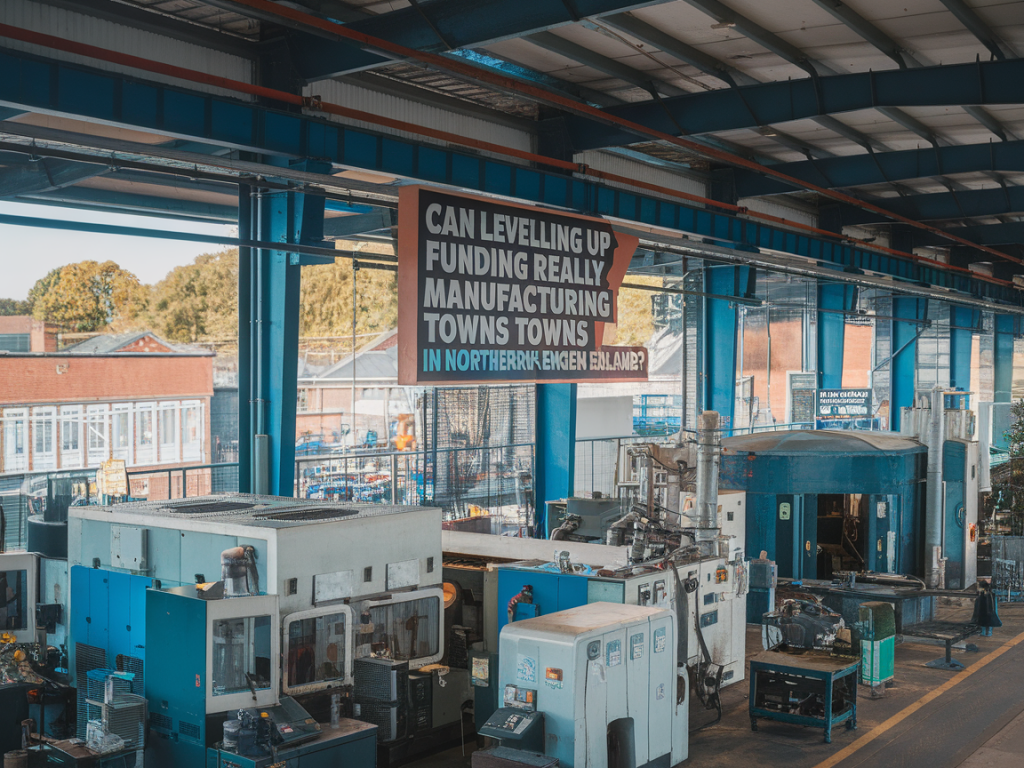
I’ve spent years travelling through northern England’s former industrial heartlands — from the terraced streets around Rotherham’s steelworks to the shipyards by the Tyne and the quieter manufacturing estates outside Sunderland. What strikes me most is how visible the potential is: vacant factory shells next to thriving small firms, once-proud high streets where a new café sits beside a boarded shop, and communities that still have the skills and pride that built modern Britain. The question is whether levelling up funding can reliably convert that potential into lasting industrial revival — and if so, what needs to change for it to work.
What levelling up funding actually is
When people talk about “levelling up” they mean a suite of policies and pots of money that Westminster has used to try to reduce regional inequalities. The best-known programmes include the Levelling Up Fund (LUF), the Towns Fund (including Town Deals), and various investment streams for local transport, skills, and innovation. These funds aim to plug gaps in infrastructure, improve town centres and support local regeneration projects.
In practice, levelling up funding has been a mix of capital grants for visible infrastructure and competitive bids that require local authorities to present coherent, place-based plans. That format has strengths — it pushes councils and local partners to be strategic — but also weaknesses: it favours places with more capacity to bid and can be too short-term for heavy industry revival.
Where funding has helped — and why
There are small but telling successes. The Advanced Manufacturing Research Centre (AMRC) at Sheffield, born from industry-university partnerships, shows how targeted investment in R&D can anchor high-value manufacturing. The AMRC’s work with Rolls-Royce and SMEs has created clusters where knowledge, skills and firms reinforce each other. I’ve met apprentices there who chose to stay in the region because the training pipeline and employer demand matched up.
On Teesside, investment in port infrastructure and the Teesworks site (despite controversies) illustrates another approach: using derelict brownfield land for new industrial capacity, linked to logistics and energy projects. And Nissan’s plant in Sunderland demonstrates the role of a global anchor employer in sustaining local supply chains and jobs — though the plant’s future remains tied to global demand and corporate strategy.
Why funding alone rarely revives manufacturing towns
- Short-term pots vs long-term industrial cycles: Manufacturing recovery needs patient capital. A five-year grant can build a unit or retrain workers but can’t create markets or multi-decade supply relationships.
- Skills mismatch: Many funding rounds don’t align tightly with the skills employers actually need. Adult retraining programmes are useful, but firms often need engineers, CNC operators and production managers — not just generic employability courses.
- Infrastructure bottlenecks: Good roads, rail freight links and energy capacity matter. A shiny business incubator won’t help if the local grid can’t support electrified processes or if freight links remain poor.
- Fragmented institutions: Local authorities, Mayoral Combined Authorities, LEPs (legacy bodies) and private sector partners must coordinate. Where they don’t, projects stall.
- Market risk: Firms need demand. Without assured procurement pipelines — for example, public sector contracts or anchor buyers — it’s hard to scale manufacturing.
What good levelling up looks like for manufacturing towns
From my reporting, the places that have made the most progress share certain features. These are practical lessons for policymakers and local leaders.
- Long-term, predictable funding — multi-decade commitments (or mechanisms like infrastructure banks) allow firms and investors to plan plant upgrades and workforce development.
- Aligned skills systems — technical colleges, apprenticeships and employer-led training tailored to local sectors. Successful towns work with nearby universities and FE colleges to create clear training pathways into local firms.
- Strong anchor institutions — universities, big employers or ports can be focal points for cluster growth. Partnerships with firms such as Nissan, Siemens or BAE Systems can leverage private R&D and procurement.
- Focused sector strategies — towns should target industries where they have an advantage, not chase every sector. For example, parts suppliers, advanced composites, battery assembly or food processing each require different interventions.
- Brownfield regeneration with de-risking support — remediating contaminated sites and improving utility connections is costly; public funding can de-risk early-stage development to attract private capital.
- Local procurement and anchor-buying — councils and NHS trusts can prioritise local suppliers where quality and price match, helping to scale local manufacturing SMEs.
Real-world barriers that still need fixing
Even with the best plans, there are persistent problems. Planning and environmental permitting for industrial investment can be slow and uncertain. Pension funds and institutional investors often perceive smaller northern projects as higher risk. And the UK’s business support landscape is still complex and fragmented — firms tell me they don’t always know where to go for R&D grants, export assistance or capital.
Energy is another sticking point. The shift to electrification and low-carbon manufacturing is essential, but many industrial estates lack sufficient grid capacity. Projects that could become world-class — for instance, battery assembly or hydrogen-ready processes — can be stalled by network constraints.
What local leaders and Whitehall can do differently
From conversations with mayors, council leaders and business owners, I’ve distilled some practical steps:
- Create multi-year investment frameworks that bundle capital, skills and innovation support rather than funding single visible projects.
- Set up “one-stop” industrial growth hubs — offices that guide firms through grants, planning, land acquisition and skills recruitment.
- Use public procurement strategically to create demand for local manufacturing, especially in health, transport and retrofit sectors.
- Negotiate grid upgrades and green energy deals as part of industrial strategies, to attract low-carbon manufacturing that will be globally competitive.
- Support scale-up for SMEs with patient capital and links to larger firms that can offer orders and expertise.
Why I remain cautiously optimistic
Levelling up funding has not been a silver bullet — but it has sometimes catalysed partnerships and cleared obstacles. Where funds are used to join the dots between training, R&D and infrastructure, towns can attract higher-value manufacturing. The key is treating industrial revival as a long-run project: creating ecosystems, not just buildings.
As someone who’s walked these streets and sat in meeting rooms with council officials and factory managers, I’ve seen genuine commitment and ingenuity. The north has the workforce, the industrial legacy and increasingly the political focus. With smarter, patient funding and stronger local–national coordination, levelling up could turn pockets of potential into sustainable, modern manufacturing hubs — but only if the next stage of policy learns from the places that have worked and from those still waiting for a chance.