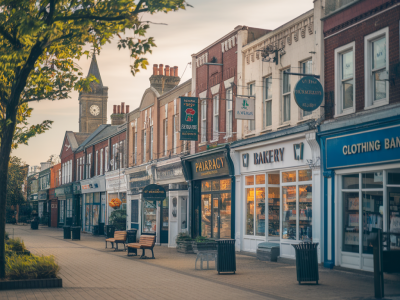
I walked past my local bookshop last week and felt that familiar tug: the warm disorder of paperbacks stacked by the door, a poster for an author event, the sight of a cashier who knows regular customers by name. Independent bookshops are a small but vital thread in the fabric of our high streets. Yet many are struggling under rising costs, squeezed margins and an inflexible business rates system that was designed for a different retail era. Could a targeted business rates holiday be the lifeline these shops need — and what would it actually look like in practice?
Why business rates matter so much to bookshops
Business rates are effectively a tax on property occupied by businesses. For a small bookshop operating from a 1,000–2,000 sq ft premises in a market town or suburban high street, rates can represent a significant proportion of operating costs — sometimes more than rent or staff. Unlike larger chains with diversified income streams, many independents run on tight margins: gross margins on books are typically lower than on cafés or fashion, and publishers' discounts limit flexibility.
Ask any shop owner and they’ll tell you that a bill rise of a few thousand pounds can be the difference between hosting author events and cutting opening hours. Unlike online retailers, physical bookshops also provide community value that isn’t captured in sales figures: literacy programmes, local author support, late‑night browsing, and a safe public space.
What a targeted business rates holiday would aim to do
A targeted holiday would temporarily waive or reduce the business rates bill for qualifying independent bookshops. The objectives could include:
To be meaningful, the holiday needs to be targeted (not a universal retail giveaway) and time‑bound, so it’s fiscally responsible while still delivering relief where it’s most needed.
Who should qualify — and how to define "independent"?
Designing eligibility is the trickiest part. If the scheme is too broad, it will waste public money on businesses that don’t need help; if it’s too narrow, it will miss the shops it’s meant to save.
Practical criteria could include a combination of:
These rules must be simple to administer. I’ve seen grant schemes stall under paperwork requirements that small businesses struggle to meet. A registration process through local councils, with a short, clear checklist and a fast turnaround, would increase take‑up and avoid unintended exclusions.
How long should the relief last?
Short, sharp relief — six to twelve months — can stabilise businesses, but it risks being insufficient if broader economic pressures persist. A phased approach might work better: an initial six‑month full relief followed by another six months at 50% could give shops time to adapt without creating permanent dependence.
What about fiscal fairness and broader policy trade‑offs?
Any relief costs the public purse. A targeted business rates holiday would need to be balanced against other priorities. There are several ways to offset costs:
There’s also a philosophical debate: should public policy prop up specific sectors, or should it level the playing field across all retail? My view is pragmatic. Independent bookshops deliver public goods — cultural capital, literacy, community cohesion — that market measures undervalue. That justifies a modest, targeted intervention.
What evidence do we have that rates relief helps?
Past schemes give mixed but useful signals. During the pandemic, temporary business rates reliefs helped many small retailers avoid insolvency. The data showed higher survival rates in sectors that received targeted support. However, relief alone wasn’t enough: where shops also received support to move online, access supply chains or reach customers, recovery was stronger.
So, relief should be part of a package: short‑term cashflow breathing space coupled with measures to future‑proof businesses.
Implementation challenges and solutions
There are practical issues to tackle:
Case studies and what to learn from them
Consider two hypothetical examples. "PageTurners", a beloved 1,200 sq ft shop in a seaside town, has strong local footfall but thin margins. A 12‑month rates holiday would free up funds to run a summer children’s programme, boosting weekend sales and community ties. "Chapter & Brew", a shop that successfully added a small café and a subscription service, might not need relief but would benefit from business development support instead.
| Scenario | Likely impact of targeted rates relief |
| Small high street shop with events | Stabilises cashflow, enables programming and increased footfall |
| Smaller chain (3–4 branches) | Partial relief helps but may create competitive distortion; condition on investment |
| Large national chain | Not eligible — public funds better targeted elsewhere |
Beyond rates: other ways to help bookshops
Rates relief is blunt. Complementary policies can multiply its effect:
Several councils already run creative local initiatives. Scaling those ideas alongside any national rates relief would be sensible.
Ultimately, a targeted business rates holiday could be a lifeline for many independent bookshops — but only if it’s well targeted, time‑limited and paired with measures that help shops adapt their business models. I’d rather see public money spent to build resilience and community value than to prop up unsustainable models. If we value the bookstores that animate our high streets, a carefully designed package of relief and support is a sensible investment in local culture and economic diversity.