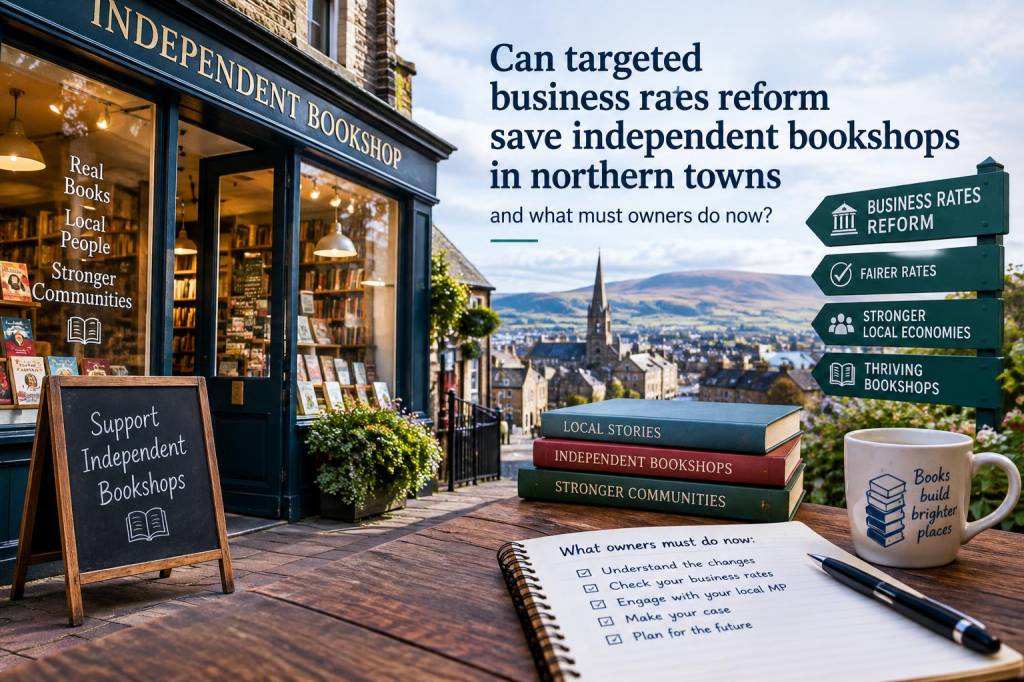
I walk past independent bookshops in northern towns every week and I can't help but measure them against the cafes and charity shops that seem to thrive on high streets. Some stores are bustling, others are quiet, and a worrying number display "closing down" posters. The conversation I keep hearing from owners, customers and local councillors centres on one thing: business rates. Could a targeted reform of business rates save these bookshops? And if reform is slow or partial, what must owners do now to survive?
Why business rates feel like a punishment for bookshops
Business rates are a tax on occupied commercial property, and for many independent bookshops — often housed in older, centrally located premises — they represent a disproportionate fixed cost. Unlike larger retailers that can spread costs over numerous outlets or sell online at scale, an indie bookshop's margins are already thin. A mismatch between property valuation and footfall can leave owners paying rates that outstrip income.
People often ask whether business rates are the root cause of closures. They’re not the only reason — competition from online retailers, rising rents, wartime inflationary pressures and changing leisure habits all matter — but they are a very visible, recurring pressure that can tip a fragile business over the edge.
What targeted business rates reform could realistically achieve
A blanket reduction in business rates might sound attractive, but it would be expensive and politically tricky. Targeted reform, however, can be both feasible and efficient. Here’s what would help bookshops in northern towns specifically:
These measures would not be an instant fix, but they would change the calculus for owners and investors by recognising the cultural and social contribution of small bookshops, not just their property value.
A practical comparison: current situation vs targeted reform
| Today (typical) | With targeted reform | |
|---|---|---|
| Rates burden | High fixed cost linked to property valuation | Reduced or tapered for independent cultural retailers |
| Local control | Limited ability for councils to target relief | Greater discretion to support community-serving businesses |
| Predictability | Revaluations can cause sudden spikes | Transitional protections and more frequent, fairer revaluations |
| Wider effects | High closures, loss of footfall | Stronger town centres, increased social value |
Limits of reform — and why it must be paired with other measures
Even the most sympathetic reform couldn’t restore sales that have moved entirely online. Bookshops are not just retail points; they are cultural venues. So reform needs to be coupled with policies that stimulate footfall and community use of town centres: better public transport links, town-centre living incentives, event funding and partnerships with libraries and schools.
There’s also the practical reality of limited council budgets and central government political calculations. Targeted relief needs to be designed so it cannot be gamed by well-resourced chains claiming cultural credentials, and it should be administratively straightforward to avoid burdening small businesses with complex applications.
What owners must do now — practical, immediate steps
If you're an owner reading this, I won’t pretend a business rates shift will arrive tomorrow. Here are the steps I’d take if I ran a bookshop in a northern town today:
How to engage with policymakers effectively
Owners shouldn’t wait for Westminster. Local councillors often control discretionary relief. I’d advise shop owners to prepare a short, evidence-based briefing for their council leader or local MP: footfall stats, rateable valuation, community activities and a clear ask (for example, a 30% discretionary reduction for cultural retail for two years). Use customer testimonies — real voices are persuasive.
Organised campaigns that tie a shop’s survival to town-centre health resonate with policymakers. Offer councils the upside too: explain how keeping bookshops open supports tourism, education and local identity, which in turn sustains council tax revenue and local economies.
Targeted business rates reform can create breathing space for independent bookshops in northern towns, but it has to be practical, well-designed and accompanied by measures that rebuild footfall and diversify income. While we wait for policymakers to act, owners have a number of concrete strategies to strengthen their businesses, document their social value and make a compelling case for support. The future of these shops will depend on smart policy and the resourcefulness of owners and communities alike.