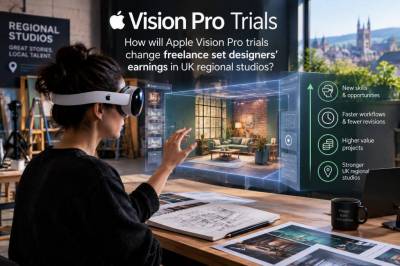
I’ve been watching the early demonstrations and limited trials of the Apple Vision Pro with a mix of excitement and caution. The headset’s promise — to blend spatial computing with high-fidelity visuals — has studios imagining a future where some location shoots, rehearsals and complex camera setups are replaced or dramatically shortened by virtual playback, previsualisation and on-set AR tools. But for regional studios and the freelancers who staff them, the practical question is: can Vision Pro trials really let teams cut shooting days, and if so, what should freelancers be negotiating now to protect their pay, rights and working conditions?
How Vision Pro might shorten shoots — and when it won’t
From what I’ve seen and heard in demonstrations, Vision Pro and similar spatial devices can speed up production in specific ways:
Previsualisation and remote blocking: Directors can walk through a virtual set with actors and department heads before anyone arrives, reducing the time spent testing angles, marking blocking and moving equipment on day one.Instant playback and AR overlays: Vision Pro can overlay virtual set elements or character cues in real scale, letting DPs and directors check compositions quickly without building full practical setups.Remote collaboration: Creative teams and clients can join feedback sessions virtually from other cities, cutting travel and scheduling friction.Location scouting alternatives: High-quality spatial video and photogrammetry can replace some physical location scouting trips, allowing teams to decide on locations faster.That said, there are limits. Vision Pro is not a replacement for large-scale practical effects, weather-dependent exterior shoots, crowds, or the tactile nuances of actors interacting with real props. Practical lighting for skin tones, complex motion capture, and certain camera rigs still demand physical days on set. So any reduction in shooting days will likely be incremental and heavily dependent on the type of production.
Why regional studios are experimenting
Regional studios operate on tighter margins than London-based counterparts. Cutting even half a day on a multi-day shoot can save on location fees, equipment hire, catering and overtime. For smaller dramas, commercials and branded content — especially productions that rely on controlled interiors and green-screen — Vision Pro-powered workflows can yield measurable savings in preproduction and transition time between set-ups.
From a practical perspective, studios are piloting trials because:
They want to show clients faster turnaround without sacrificing quality.They aim to be competitive by offering hybrid in-person/virtual production packages.They seek to reduce travel and accommodation costs for specialised crew who are scarce in the regions.What freelancers should be most concerned about
If your day rate has historically covered a full on-set workflow, the move to hybrid productions could change the scope of what’s expected during your booked days. Here are the main risks:
Scope creep: You may be asked to attend remote previs sessions for free, or to do extra virtual set preparations without additional pay.Rate compression: Studios might justify lower day rates by arguing that fewer on-set days are needed.Rights and reuse: Spatial captures and virtual assets can be reused across projects. Without clear negotiation, your performance or likeness captured for one shoot could be repurposed.Training and equipment: Expect requests to be fluent with new workflows; studios may assume you’ll supply your own tech or learn on your own time.Health and insurance: More time in headsets raises questions about eye strain, motion sickness and employer liability.Specific clauses and terms freelancers should negotiate now
When you get a contract or offer that mentions Vision Pro, XR, volumetric capture, or virtual production, ask for clear language around these points. Here’s a checklist you can use — I’ve written it in the first person so you can adapt it into your own negotiation email or clause requests:
Scope of work: “My day rate covers X hours on set. Any additional previsualisation, virtual blocking, or remote collaboration beyond X hours will be billed at my hourly/half-day rate.”Remote call compensation: “I will attend up to Y remote previs or tech calls per project included in the fee. Additional calls are chargeable at my standard hourly rate.”Usage and residuals: “Any reuse of my captured performance, voice, or likeness in future productions or marketing requires additional licensing fees. Specify territory, medium and duration.”Credits: “Standard credit for my role on all materials where credits are displayed, including digital and metaverse platforms.”Training and equipment: “If the studio requires me to use Vision Pro or associated capture tools, the studio will provide necessary training or compensate for certified training courses. If specific equipment is requested, the studio will supply or reimburse.”Health & safety and breaks: “Headset wear time limits and scheduled breaks will be adhered to. Any extended VR sessions will be compensated at an overtime rate.”IP and derivatives: “Outline how spatial scans, photogrammetry and volumetric captures of me or my props are licensed. Specify whether the studio retains full IP or grants a limited license.”Data security and privacy: “Clarify how footage and biometric data will be stored, retained and shared.”Rates to consider — not legal advice, just practical norms
I don’t advocate specific numbers — rates depend on experience, market and union status — but freelancers should consider adding these to their toolkit:
Remote/previs hourly fee: A clear hourly rate for remote sessions so studios can’t squeeze free prep out of you.Equipment/tech surcharge: If you provide your own headset or capture kit, add a daily surcharge or a hire fee.Reuse license fees: Flat fees for a single reuse; escalating fees for additional territories or perpetual use.Overtime for VR sessions: A premium to account for the extra fatigue of headset work.Practical tips for working with Vision Pro on set
From the shoots I’ve visited and the conversations I’ve had, a few practical habits help avoid friction:
Document everything: Confirm scope and hours in writing before the job — include how many previs sessions are expected.Request test time: Ask for a tech run so you can check comfort with headset interfaces and ensure your role won’t be compromised.Clarify deliverables: What exactly will you be asked to contribute to virtual assets? Will you be performing for volumetric capture or just consulting?Keep a training log: If you take studio-recommended courses, keep receipts and certificates for future negotiations.How regional studios can keep freelancers happy while saving days
It’s absolutely possible for studios to tighten schedules without shortchanging talent — but it takes transparent planning. Offer upfront budgets that carve out fees for remote work, training allowances, and clear reuse payments. If studios present Vision Pro as a tool that saves money, some of that savings should flow back to the creative and technical people delivering the project.
Questions I’m still asking
I’ve got a running list of issues I want the industry to clarify as pilots expand:
How will insurers treat headset-intensive workflows?Will trade unions update model contracts to reflect spatial capture and virtual licensing?Can regional studios pool investments in shared capture gear so freelancers don’t have to own expensive kit?How will accessibility and neurodiversity be considered when long headset sessions are used for rehearsals or blocking?If you’re a freelancer who’s already been asked to work on a Vision Pro trial, I’d love to hear how it’s gone for you — what was fair, what wasn’t, and what you negotiated that made a difference. And if you’re a regional studio running pilots, tell me how you’re balancing efficiency gains with fair pay and clear contracts. These trials could reshape how we make content outside major hubs — but only if the industry negotiates the shift intelligently, sharing both the benefits and the responsibilities.