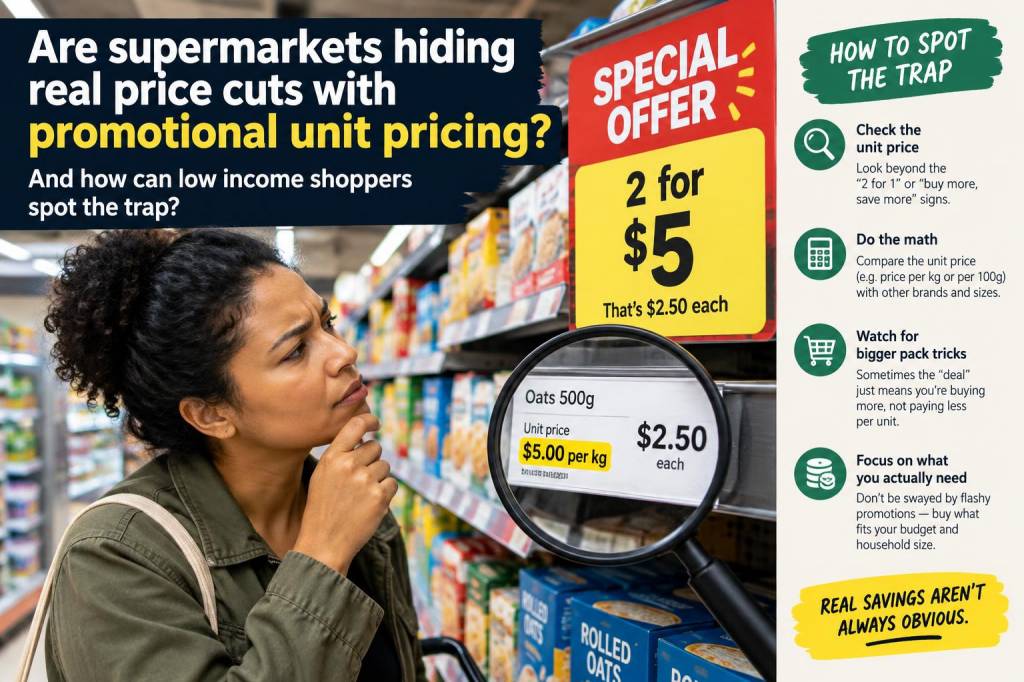
I’ve been watching the supermarket aisles for years, not just for what’s on the shelf but for how prices are presented. Lately one technique keeps cropping up that can mislead even careful shoppers: promotional unit pricing. On the surface it looks helpful — a big yellow sticker that tells you “£1 per 100g” or “Was £3.50, now £2” — but dig a little deeper and the maths sometimes tells a different story. If you’re on a tight budget, that subtle framing can mean you leave the store thinking you saved money when you’ve actually paid more per usable portion, or been nudged to buy more than you needed.
What is promotional unit pricing, and why it matters
Unit pricing is meant to help consumers compare value by showing cost per standard unit (per 100g, per litre, per item). It’s useful — especially when pack sizes vary widely. Promotional unit pricing layers on top of that: supermarkets emphasise a unit price during a discount or repackage a product into a different size with a seemingly lower unit cost. The trouble comes when the promotion relies on context or omission to make the deal look better than it is.
For example, a 300g bag of coffee might drop from £3.50 to £2.99 with a unit price displayed as “£1.00 per 100g” while a larger 500g bag sits at £3.49 with a unit price of “£0.70 per 100g” but without a prominent promotion tag. The bold signage and “save” messaging draw attention to the smaller pack, nudging shoppers into thinking it’s the smarter buy, even though the larger pack is cheaper per 100g.
How supermarkets create the illusion of a bargain
Here are the tactics I see again and again on UK shop floors:
Examples shoppers should watch for
I’ve spotted real cases with familiar brands — not as an accusation but to illustrate common patterns. A popular cereal brand might enter a “buy one, get one half price” promotion on a 375g pack, encouraging bulk buying. But if you only need one box, the unit price of the discounted multi‑pack can be more expensive than a different brand’s regular 500g box on the shelf. Similarly, own‑brand ranges often offer small price differentials between sizes; a 400g ready meal on promotion could be highlighted with an appealing unit price while a 600g family pack (cheaper per 100g) sits unmarked.
Five practical checks to spot the trap
When you’re juggling a weekly shop and a tight budget, it helps to have a quick checklist:
Quick mental math (no calculator needed)
If you want to do a fast check while you’re in the aisle, here’s a simple method: take the price and divide by the weight in the same units (use decimals). For example, a £2.40 jar of pasta sauce weighing 400g: 2.40 ÷ 4 = £0.60 per 100g. For litres, the method is the same: £1.50 for 750ml becomes 1.50 ÷ 0.75 = £2.00 per litre. Once you’ve done this a few times you’ll spot bargains at a glance.
| Item | Price | Weight/Volume | Unit price |
|---|---|---|---|
| Brand A cereal (375g) | £2.20 | 375g | £0.59 per 100g |
| Brand B cereal (500g) | £2.90 | 500g | £0.58 per 100g |
| Own brand cereal (2 for £4) | £4.00 (two x 375g) | 750g total | £0.53 per 100g |
In this hypothetical, the multi‑buy looks better per 100g — but only if you need or can use both packs before they go off. For shoppers on a tight income who risk waste, the multi‑buy can be a false economy.
Special considerations for low‑income shoppers
Unit pricing is most useful when you can afford to buy in bulk and store items. For people on limited budgets who have less storage, smaller households, or limited cooking facilities, buying larger packs can be impractical even when cheaper per unit. That’s why promotions on smaller packs are targeted: they match purchasing patterns but can be costlier in the long run.
Practical advice for low‑income households:
What regulators and retailers say — and what they could do better
Retailers have a legal obligation in the UK to make unit pricing available for pre‑packaged goods where unit pricing is relevant. Many do — but the presentation, placement and prominence vary. Consumer groups have long argued for more standardisation: clearer, uniform unit price labels, consistent placement on shelves and stricter rules about promotional labelling that must show the comparison clearly (e.g., clearly stating the previous unit price alongside the new one).
Retailers can also help by ensuring digital shoppers see the same unit price information online and by training staff to answer quick unit price questions. For shoppers who rely on mobile ordering, supermarket apps that surface unit price comparisons and best deals could make a real difference.
My takeaway from years of watching the aisles
Big yellow stickers and “save” banners will always command attention — they’re designed to do that. As a shopper, the best defence is a little scepticism and a few quick checks. Unit pricing can be a powerful tool for saving money, but only if it’s presented honestly and you know how to use it. If you’re on a tight budget, don’t let the bright labels dictate your choices: understand the maths, consider storage and waste, and if possible, partner with others to buy in bulk. Little habits — checking unit prices, doing a quick mental calculation — add up to real savings over time.