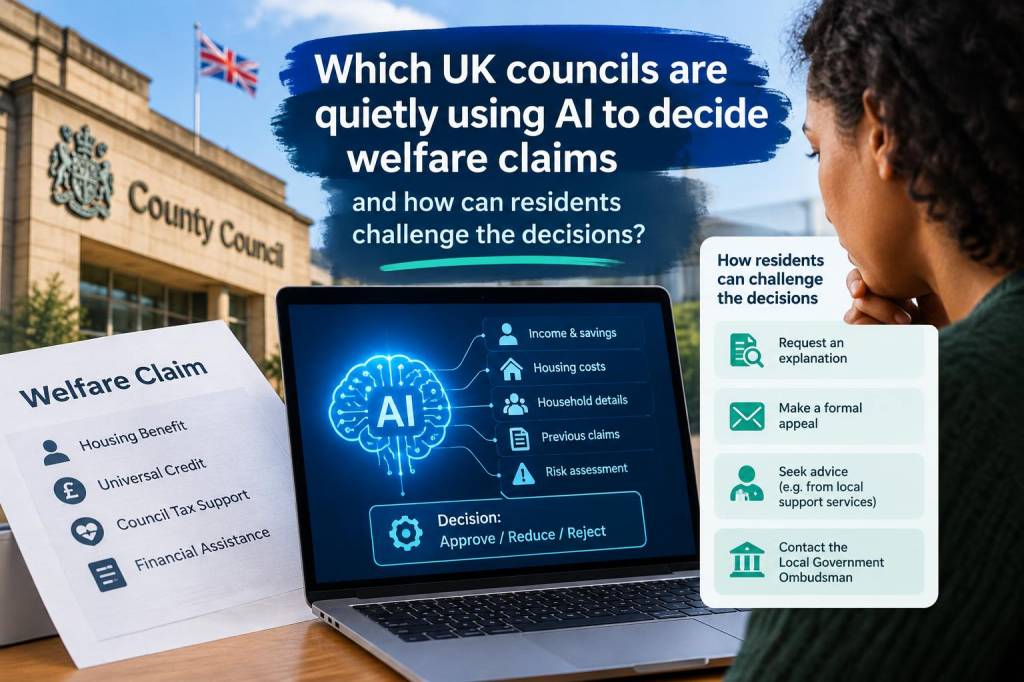
I’ve been following how local government quietly adopts automated tools for years, and one trend that worries me is the growing use of algorithmic systems to assess or flag welfare claims. These systems are often sold as ways to speed up processing, detect fraud or prioritise cases. In practice, they can upend people’s livelihoods if decisions are based on opaque scoring, automated matching or rules built into software they never see.
Which councils are using AI and automated tools — and how quietly?
There isn’t a single public list that names every council using “AI” to help with benefits or social care decisions. What we do know — from council contracts published through transparency notices, FOI responses and investigative reporting — is that many local authorities have introduced elements of automation in benefits processing, fraud detection and case triage.
Large metropolitan councils and unitary authorities are more likely to buy complex case-management and fraud-detection software because they process higher volumes of claims. Smaller councils often rely on the same third‑party providers (and therefore the same underlying systems) through shared contracts or regional collaborations.
Typical places where automated tools appear include:
Some councils explicitly publish procurement notices for software from suppliers such as Civica, Capita, Northgate or Experian — vendors that provide case management, data matching and analytics. Other contracts reference “predictive analytics” or “risk stratification” without detailed public explanation. That language can mask quite powerful decision-support tools.
What does “AI” mean in this context?
In council use, “AI” often means one or more of the following:
Not all are machine learning. A lot of what’s labelled “AI” is essentially complex rules and scoring derived from historical data. But the outcomes can still be automated and consequential.
Why this matters — real impacts I’ve seen or reported on
When a system incorrectly flags a claim or deprioritises it, the consequences are immediate: delayed payments, benefit refusals, threats of recovery or removal of housing support. I’ve seen cases where people had to spend weeks chasing explanations and providing paperwork to reverse an automated hold — time and stress they could ill afford.
Because the logic behind the systems is often buried in supplier code or high-level procurement documents, residents struggle to understand why decisions were made and how to correct errors. That lack of transparency causes avoidable harm.
How residents can challenge automated decisions — practical steps
If you or someone you know suspects a council decision was influenced by an automated system, here’s a clear set of actions I recommend. I’ve used these approaches myself when investigating algorithmic harms, and they’re backed by legal and regulatory routes available in the UK.
What to ask for in a Subject Access Request — template points
| Ask for | Why |
| All personal data relating to my welfare/benefit claim | To see what was held and used to make decisions |
| Any automated decision outputs, scores or risk assessments | To understand algorithmic factors affecting the outcome |
| Copies of the rules/logic or model descriptions used | To challenge errors or bias in the decision process |
| Logs of automated actions (timestamps, who/what triggered a change) | To show when and how decisions were applied |
Who to contact if the council stonewalls
If you hit resistance, these are the most useful escalation points:
What I want to see councils do differently
From where I sit, councils should publish simple algorithmic impact assessments, explain when automated tools are used and ensure every automated outcome has a clear route to rapid human review. Suppliers such as Civica or Capita and analytics vendors must be transparent about how their models are trained and what data they use.
Residents shouldn’t have to be data experts to challenge a decision that affects their home or income. That’s why I keep pressing for stronger transparency and better safeguards — and why I recommend you request explanations, use your SAR rights and escalate to the Ombudsman or ICO if needed.
If you want, I can help draft a SAR or a complaint letter you can send to your council. Tell me which council it is and what happened, and I’ll write a template you can adapt.