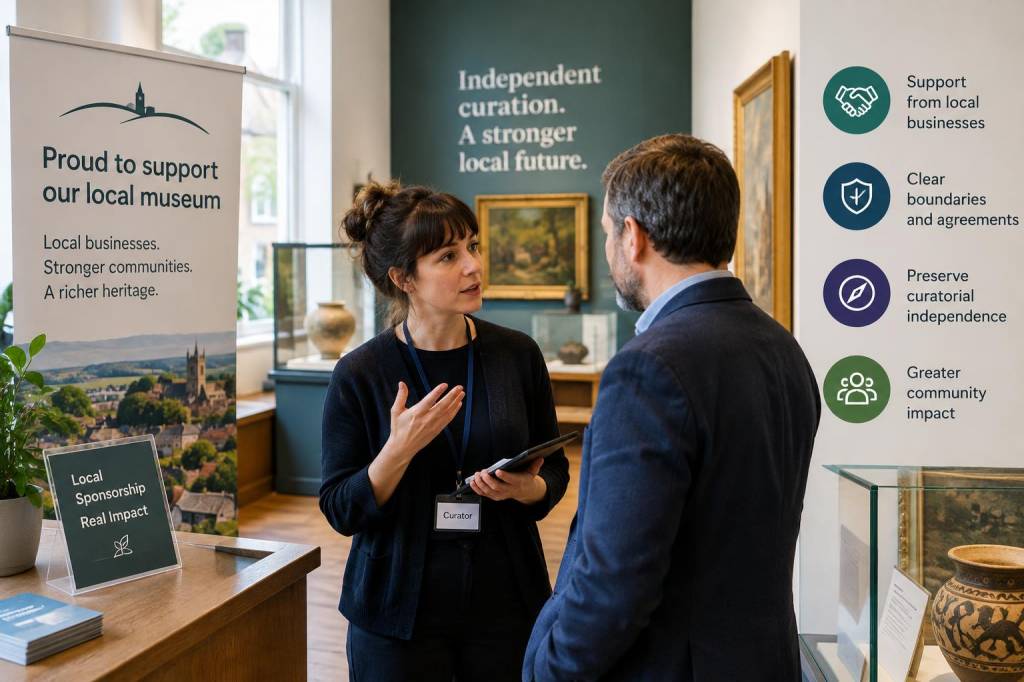
I have seen a growing number of small UK museums face the same pressure: they need money for exhibitions, conservation, education, and buildings, yet they also need to stay trusted, independent, and intellectually honest. In my view, local sponsorship can be part of that answer, but only when it is treated as a relationship with clear boundaries rather than a blank cheque. When a museum accepts support from a local business, a family trust, or a regional employer, it should never feel as if it has rented out its voice.
That balance matters because museums are not simply visitor attractions. They are civic spaces where memory, research, identity, and public debate meet. Once curatorial independence is weakened, people notice very quickly, even if no one says it out loud. A label that feels softened, a controversial subject that disappears from a display, or a programme shaped to flatter a donor can damage trust in ways that are hard to repair. I have spoken with curators who would rather lose money than lose credibility, and I understand why. Reputation is one of a museum’s most valuable assets.
What local sponsorship can actually do
When I talk about local sponsorship, I am not talking only about giant corporate logos on gallery walls. In smaller museums, sponsorship often comes in practical, modest forms: funding for a school workshop series, support for a temporary exhibition, help with digital cataloguing, or contributions toward roof repairs and climate control. A local engineering firm might fund a science and industry display. A family-run bank might support oral history work. A nearby restaurant group might help underwrite an evening programme. These links can be mutually beneficial when they are built on shared place-based pride rather than control.
I think local sponsorship works best when it is specific. A sponsor can support activity, while curators retain control over content. That distinction sounds simple, but it is often the most important line in the room. A business may be willing to fund transport costs for schools, but it should not decide which historical figures deserve inclusion. A charity may underwrite a display, but it should not influence how a contested local event is interpreted. When that line is respected, sponsorship can strengthen public access without compromising scholarship.
Set boundaries before money changes hands
One lesson I keep returning to is that curatorial independence is protected long before a contract is signed. If a museum waits until a sponsor is already emotionally invested, the boundary becomes harder to defend. I would always want to see a written sponsorship policy that is short, plain, and public. It should explain what sponsors can support, what they cannot influence, and who has final editorial responsibility.
That policy does not need to sound defensive. In fact, the clearer it is, the easier it becomes to welcome support with confidence. I would include rules on several points:
- Final authority over interpretation remains with museum staff and trustees.
- Sponsors may support programmes, spaces, or events, but do not approve labels, acquisitions, research findings, or public statements.
- Any recognition of sponsorship stays proportionate and does not dominate visitor experience.
- Conflicts of interest are declared early and recorded.
- Gift agreements include exit terms if values or behaviour change.
In my experience, people are often more comfortable with firm rules than vague promises. A sponsor who genuinely wants to help will usually respect a museum that knows its own limits. A sponsor who wants influence will often reveal that intention once boundaries are stated clearly.
Use transparency as a form of protection
Transparency is not a public relations flourish; it is a shield. I have noticed that museums sometimes worry disclosure will make visitors suspicious, but secrecy is far more damaging than openness. If I walk into a museum and see a local company named as a supporter, I want to know what that support covered and whether curators retained independence. That kind of disclosure does not weaken trust. It builds it.
Good transparency can take several forms. A museum website can list supporters and explain the nature of each contribution. Gallery panels can note when a display was funded externally. Annual reports can describe sponsorship income alongside governance safeguards. If there has been any potential overlap between a sponsor’s business interests and a museum subject, that should be explained in plain language. The point is not to overwhelm visitors with paperwork. It is to show that the museum has nothing to hide.
I also think transparency helps staff. When sponsorship agreements are open and understandable, curators feel less isolated. They know where the lines are, who has their back, and how decisions were made. That internal clarity matters just as much as public confidence.
Choose sponsors whose values fit the museum’s mission
I would never say that every local business is a suitable sponsor simply because it is local. Geography alone is not enough. A museum should ask whether a sponsor’s public reputation, business model, and community role are compatible with the institution’s values. If a museum works on environmental history, for example, it may need to think carefully about backing from a company whose record in that area could create pressure or controversy. If a museum explores labour history, social justice, or migration, it should consider whether a sponsor could be seen as shaping the story for reputational benefit.
This is not about purity tests. It is about judgment. I believe museums can work with a wide range of local supporters if they remain honest about the risks. Some partnerships are perfectly appropriate because the sponsor shares a genuine interest in education, heritage, or community access. Others may look attractive financially but come with hidden costs. A museum that chooses carefully is not being ungrateful; it is being responsible.
| Partnership area | Acceptable sponsor role | Risk if boundaries are weak |
|---|---|---|
| School outreach | Fund transport, materials, staffing | Pressure to shape educational content |
| Temporary exhibition | Cover production and display costs | Influence over theme or interpretation |
| Building repair | Support conservation work | Expectation of public branding dominance |
| Digital access | Help with cataloguing or scanning | Restrictions on what can be digitised |
Keep trustees and curators aligned
In smaller museums, tension often appears not because a sponsor is aggressive, but because governance is unclear. Trustees may focus on survival, while curators focus on meaning, and both instincts are valid. If those groups do not agree on principles in advance, sponsorship can become a source of friction. I have found that museums do better when trustees ask curators what would genuinely help, rather than deciding first and consulting later.
Curators should also feel able to say no. That sounds obvious, yet many cultural workers know how hard it can be to resist financial pressure. A museum board should support staff who decline a funding offer that comes with uncomfortable strings. If independence can only be defended after a fight, then the institution has already allowed the wrong culture to form. Healthy governance means the museum does not need heroic resistance every time a sponsor appears.
Regular internal review helps too. A museum can revisit sponsorship arrangements once a year and ask a few hard questions: Has any supporter tried to influence interpretation? Has public messaging remained clear? Have staff felt protected? Has the partnership still served visitors rather than donor vanity? I would rather see this kind of honest check-in than a polished brochure full of vague gratitude.
Make room for community voice, not only donor voice
One mistake I see from time to time is a museum becoming so focused on pleasing sponsors that it forgets local communities are also stakeholders. If a museum is rooted in a town, district, or region, it should listen to residents, volunteers, schools, artists, and community historians as carefully as it listens to funders. Local sponsorship should strengthen that civic bond, not replace it.
I believe museums earn long-term loyalty when they show that sponsorship does not buy silence. If a display examines industrial pollution, social inequality, or contested local memory, the museum should still tell the story fully. Visitors often respect institutions more when they see difficult subjects handled with care and courage. A museum that softens everything to avoid upsetting a sponsor may gain a quiet cheque today and lose public trust tomorrow.
For smaller museums especially, there is real value in naming this principle aloud: support is welcome, control remains public. That message can be part of fundraising material, volunteer training, board discussions, and visitor communication. Once it becomes part of institutional habit, sponsorship feels less like a threat and more like a tool.
Build partnerships that serve learning first
When local sponsorship works well, I usually see one common thread: learning comes first. The sponsor wants to help more people understand local history, art, science, or memory. The museum wants room to interpret honestly. Visitors get access, schools get resources, and the community gets a stronger cultural institution. That is the kind of exchange I can support without reservation.
I also think museums should be willing to say that they are not looking for a patron to shape their voice. They are looking for allies who respect expertise. If a sponsor can accept that role, a partnership can be meaningful and durable. If not, the museum should walk away. Independence is not a decorative extra. It is part of what gives a museum its authority, and once I see that clearly, I find it much easier to judge every sponsorship request with a steady hand.