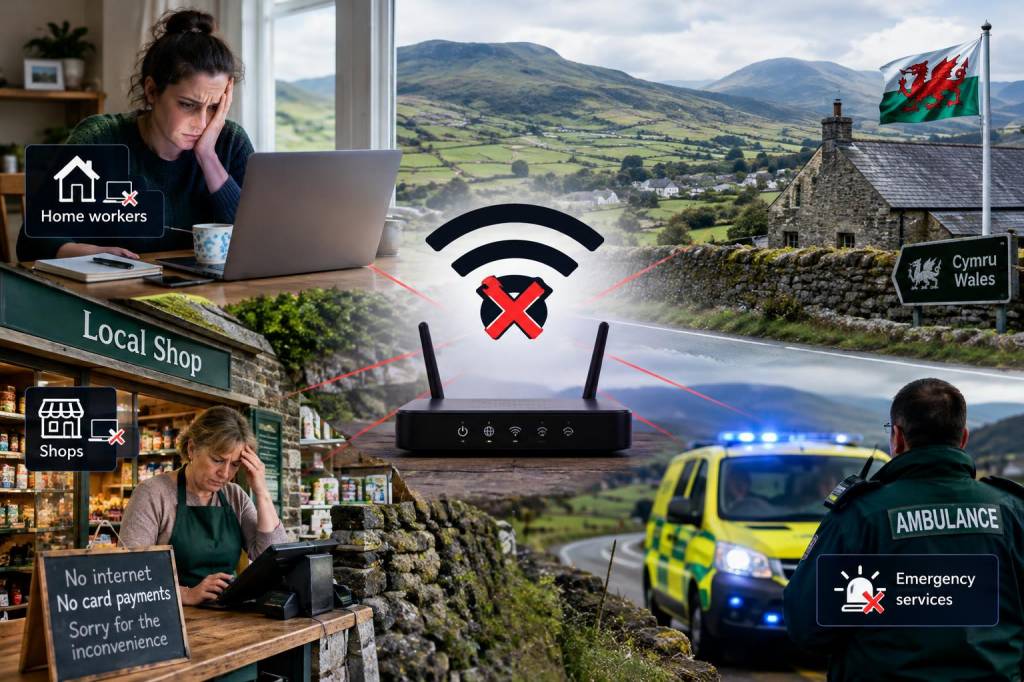
I have seen broadband failures in rural Wales turn into far more than a nuisance. When a connection drops in a small community, it does not just interrupt streaming or slow down a video call. It can stall a day’s work, freeze a till in a shop, and make it harder for urgent calls to reach the right people at the right moment. In places where roads are narrow, phone signals can be patchy, and businesses often run on slim margins, a single outage can ripple through daily life very quickly.
Why a weak connection becomes a major problem so fast
In a city, many people have a backup without even thinking about it. There may be another network nearby, mobile coverage is usually stronger, and public services are closer together. In rural Wales, I have learned that resilience is thinner. A home worker may rely on one fixed line and one mobile provider. A farm office may use broadband for banking, orders, weather data, and supplier contact. A village shop may depend on card payments and online stock systems. When that link goes down, there is rarely an easy replacement.
That is why an outage in a remote area does not behave like a minor technical fault. It becomes a shared local event. A parent trying to join a remote meeting, a shop owner waiting for a delivery update, and a resident needing to contact medical services can all be affected at once. The problem is not only speed. It is dependability. People in rural communities often plan their routines around a connection they trust. When that trust breaks, a whole chain of plans can collapse.
Home workers lose time, income, and momentum
I think one of the most overlooked effects is the strain on home workers. Since remote and hybrid working became more common, many people in rural Wales have built their work lives around broadband. That has allowed them to stay in their communities without leaving jobs behind. But if the connection fails during a workday, they may miss calls, fail to upload files, or lose access to cloud tools.
For some, that means a few frustrating hours. For others, it means lost income. Freelancers, contractors, and small business owners can be hit especially hard because they often do not have paid downtime or a dedicated IT team to sort things out. I have spoken to people who end up driving to a town just to send a document, join a meeting from a car park, or find a café with a stronger signal. That is not flexibility. That is survival mode.
There is also an emotional cost. Remote work is supposed to offer balance, yet repeated outages create anxiety. People begin to wonder whether they can keep their job from a rural address at all. Some feel forced to choose between living where they want and working where they can. That is a deeply unfair pressure to place on households that already help sustain local communities.
Shops and small firms feel every interruption immediately
Local shops, cafés, repair services, and small trades businesses often have very little room to absorb disruption. In many places across Wales, card payments, online bookings, digital invoices, and delivery updates all depend on broadband. If a payment terminal cannot connect, a shop may need to accept cash only. That sounds simple, but many customers do not carry much cash anymore.
For a small business, even a short outage can mean:
- missed sales at busy times
- delayed card payments and unhappy customers
- problems checking supplier orders
- difficulty updating social media or websites
- extra admin once service returns
The damage is not always dramatic in one day, but it accumulates. A business owner may lose confidence in online ordering systems. A customer may decide to go elsewhere next time. Staff may spend hours catching up on work that should have taken minutes. Over time, this creates a hidden cost that is easy to underestimate from outside the community.
I also think rural firms are often expected to be more patient than they should be. People say, “That is life in the countryside,” as if patchy infrastructure were a natural feature like rain or hills. It is not. Reliable broadband is now basic business infrastructure. Without it, rural enterprises are asked to compete with one hand tied behind their back.
Emergency services and public safety can feel the strain
The most serious concern is public safety. Emergency services do not simply need broadband for convenience; they need it for speed, coordination, and accurate information. A rural outage can complicate everything from call handling to data sharing. If local systems are slowed, responders may have less immediate access to maps, records, or updates from other agencies.
That matters in a region where distances can already be long and weather can change quickly. If someone is injured on a remote road, if a farm accident happens, or if a vulnerable resident needs help, delays in communication can become dangerous. Even when mobile networks still work, coverage is not always reliable in valleys, hills, or isolated homes. A patchy digital setup is not enough when seconds matter.
There is another issue too: public services increasingly assume online access. Appointment systems, service updates, and internal coordination tools all rely on connectivity. When broadband fails, it does not just interrupt private life. It can also make it harder for councils, health services, and responders to keep operations moving smoothly. That is why outages deserve to be treated as a resilience issue, not merely a telecom complaint.
What makes rural Wales especially vulnerable
Rural Wales faces a mix of geographic and structural challenges. Hills, scattered homes, long distances between settlements, and weather exposure all make network maintenance harder. But geography is only part of the story. Investment has often been uneven, and some areas still experience lower-quality service or slower repairs than urban places.
In my view, the frustration grows when communities are told that full coverage is almost here, only to experience repeated faults. People do not need glossy promises. They need service that works on a wet Tuesday afternoon when children are trying to do schoolwork, a farmer is checking livestock information, and a shop owner is serving customers. That is the real test.
There is also a fairness question. Rural households often pay similar prices to urban customers, yet they may receive a less stable connection. That creates a sense of being asked to pay metropolitan rates for countryside reliability. It is one reason broadband failures can feel personal. They are not just technical events; they are reminders of unequal access.
What people do when the network fails
When broadband collapses, rural communities improvise quickly. People share passwords for mobile hotspots, move tasks to whatever device still has signal, and pass messages by phone or even in person. I have seen businesses pin handwritten notices to doors, explaining that card machines are down. Some people keep spare cash for exactly this reason. Others store documents offline just in case they need them.
That flexibility is admirable, but it should not be mistaken for a solution. Communities should not have to build their own emergency workaround for a service that ought to be dependable in the first place. Still, these habits reveal something important about rural Wales: people adapt fast, support each other, and find ways through disruption, even when the system lets them down.
| Group | Common impact during an outage | Immediate workaround |
|---|---|---|
| Home workers | Missed meetings, delayed files, lost productivity | Mobile hotspot, travel to stronger signal area |
| Shops and small firms | Card payment failure, stock delays, customer complaints | Cash-only sales, manual notes, later catch-up |
| Emergency services | Slower coordination, weaker access to live data | Fallback channels, radio, mobile networks where available |
| Households | Schoolwork disruption, lost contact, stress | Phone calls, offline work, neighbour support |
What people usually ask me when outages keep happening
People often ask whether this is really a broadband issue or a wider infrastructure problem. My view is that it is both. Broadband faults expose the fragility of local resilience. They show how much daily life now depends on a service that many still treat as optional. The truth is that connectivity has become as essential as roads for many households and businesses.
Another common question is whether 5G and mobile data can fill the gap. Sometimes they can, but not always. Coverage is uneven, data limits can be restrictive, and mobile signal itself can fail in remote terrain. A backup is only useful if it is genuinely reliable. In many parts of rural Wales, that still is not guaranteed.
People also ask what should happen next. From where I stand, any serious response has to include stronger maintenance, faster repair times, clearer communication during faults, and more realistic planning around rural geography. It also means listening to the people who live with these problems every day, not only the firms that sell the service.
When I think about broadband outages in rural Wales, I do not think about abstract download speeds. I think about a village shop owner trying to keep doors open, a worker trying to keep a job alive from a kitchen table, and a paramedic or dispatcher needing clear information in a hurry. Those are not separate stories. They are connected by the same fragile line.