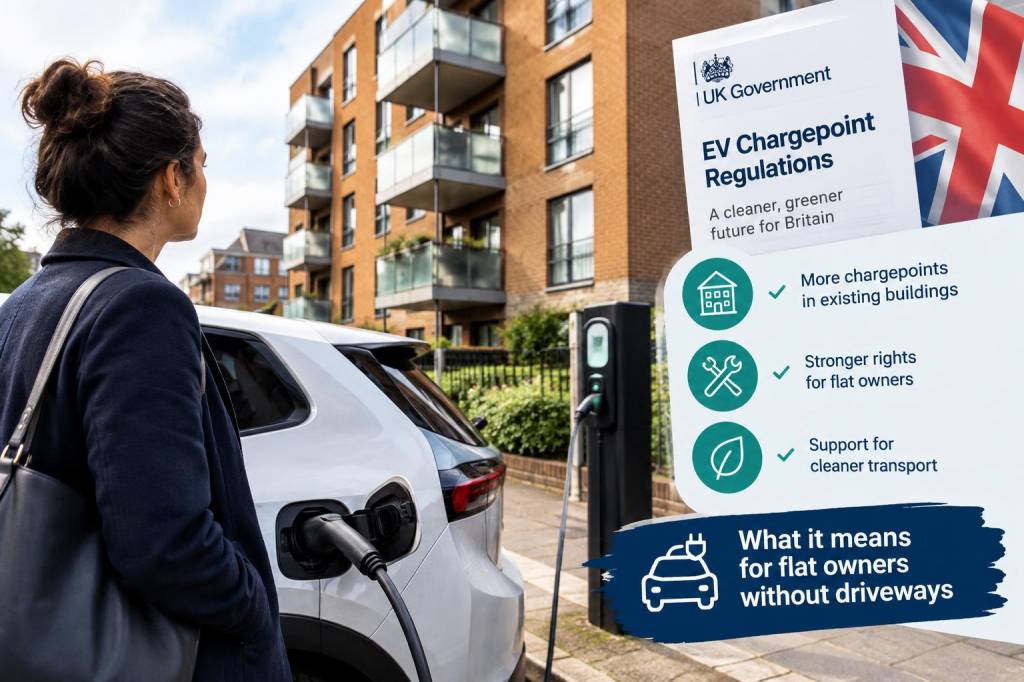
I have been thinking a lot about Britain’s new electric car charging rules because they touch a very ordinary problem that millions of people face: where do you plug in a car if you do not have a driveway? For anyone living in a flat, a terrace, or a converted house with on-street parking, electric motoring has often felt like something designed for people with private off-road space. These new rules are meant to change that balance, and in practice they could make a real difference to everyday life in cities and suburbs.
What matters most, in my view, is not the policy language itself but what it means at kerb level. If I live in a flat and park on a public street, I want to know whether I can charge easily, how much it will cost, who pays for the infrastructure, and whether my council or landlord will actually move quickly enough to make it usable. Those are the questions that matter far more than any headline about clean transport.
What has changed
Britain is making it easier for more homes and streets to support electric vehicle charging, especially in places where residents do not have private driveways. In simple terms, the direction of travel is toward wider access, more street-based charging, and fewer planning hurdles. That is important because a huge share of potential electric car owners simply cannot install a charger on their own property.
For flat owners, this is significant because it shifts the discussion away from a narrow assumption that every driver has a front garden or garage. I have long felt that this was one of the biggest blind spots in the electric vehicle rollout. National policy often speaks to homeowners with parking space, while leaving renters and apartment residents to fend for themselves. These new rules recognise that Britain’s housing stock is mixed, crowded and, in many places, old.
The practical effect is that local authorities, landlords, housing associations and charge point operators are being pushed to make public and shared charging more accessible. That can include on-street chargers near homes, charging bays outside blocks of flats, and permission pathways that are simpler than before. None of that sounds glamorous, but if you live in an urban postcode, it can be transformative.
Why flat owners have been left behind
I think it helps to be blunt about the problem. Installing a home charger is straightforward when I own a house with a driveway. It becomes far more complicated when I live in a block with communal parking, limited cable routes, or spaces I do not own. If I rent, I may also need landlord approval, freeholder approval, and possibly permission from a management company. That can turn a simple upgrade into months of correspondence.
There is also the matter of street clutter. Councils have worried about trailing cables crossing pavements, creating hazards for pedestrians, wheelchair users, children and people with pushchairs. That concern is legitimate. But in my experience, the answer is not to pretend flat owners do not exist. It is to expand infrastructure so people can charge without turning public space into a mess of extension leads.
Another issue is fairness. Electric driving has sometimes looked like a technology for the already advantaged: people who own houses, have parking, and can absorb upfront costs. If Britain wants broader adoption, it has to make charging feel normal for everyone, not just for people living in the most convenient housing situations.
What this means in daily life
If I were a flat owner considering an electric car, I would now look at three practical changes. First, charging access should become more local. Second, councils may be more willing to approve on-street charge points. Third, landlords and freeholders may face stronger pressure to cooperate rather than delay.
In daily terms, that could mean finding a charger within a short walk of home instead of driving across town to fill up. It could also mean more reliable overnight charging near residential streets. That matters because convenience is one of the main reasons people hesitate to switch. An electric car makes sense only when charging feels routine, not like a special expedition.
I also think these rules will change buying behaviour. If I know my street is getting chargers, I am more likely to consider a used electric car, especially if my commuting pattern is predictable. That could widen the market beyond early adopters and company-car drivers. It may also support second-hand values by making more neighbourhoods viable for ownership.
What landlords and councils need to do
The success of these rules will depend on delivery, not intention. If councils move slowly, residents will still feel stuck. If landlords treat every request as a nuisance, the policy will look good on paper and weak in reality. I have seen too many public initiatives lose momentum because no one owns the follow-through.
For landlords, the question is whether charging is treated as an optional extra or part of modern housing. A block without charging provision may soon look dated in the same way that buildings without decent broadband or secure bike storage now feel behind the times. For councils, the challenge is planning, street management and coordination with energy networks. A charger on a map is not enough; it has to work, be maintained, and be fairly distributed.
There is also a financial question. Someone has to pay for installation, grid upgrades and ongoing maintenance. In some cases that cost will be shared between public funding, private operators and residents. Flat owners will want clarity on whether they face installation charges, subscription fees or higher parking costs. I would expect those debates to become more common as schemes expand.
What I would watch before buying an electric car
If I lived in a flat without a driveway, I would not rush into a purchase until I had checked a few things carefully.
- Whether my street already has public chargers nearby
- Whether my council has approved new residential charging sites
- Whether my landlord or management company allows charger installation in shared parking areas
- What tariff applies at nearby chargers, especially overnight rates
- Whether I can park near a charger consistently enough to make ownership realistic
I would also pay attention to vehicle range and charging speed. A driver with no driveway may need a car that can handle infrequent but efficient top-ups, especially if nearby chargers are occupied at busy times. That makes range planning more important than for someone with a private home charger.
Then there is the question of cost. Public charging is often more expensive than charging at home, and that difference matters. If I cannot plug in cheaply overnight, I need to calculate whether the monthly running costs still beat petrol or diesel. The policy may improve access, but access alone does not guarantee affordability.
The wider market effect
I think these rules could reshape the electric vehicle market in Britain more than many people realise. A lot of commentary focuses on company fleets and wealthy early adopters, but the next stage of growth depends on ordinary households in ordinary postcodes. Once flat owners have credible charging options, the customer base widens dramatically.
That wider market could benefit car makers, charge point operators, energy firms and local contractors. It could also increase demand for better software, easier payment systems and more transparent pricing. In other words, the infrastructure conversation is not just about plugs in the pavement; it is about creating an ecosystem that feels predictable and fair.
I also expect competition among charger networks to matter more. If I live in a flat and use public charging regularly, I want reliability, clear pricing and a nearby location that is not constantly broken or blocked. The operators that solve those frustrations will win loyalty. Those that do not will be ignored, even if the policy framework is generous.
| Issue | What changes for flat owners | Why it matters |
|---|---|---|
| Access | More street and shared-space chargers | Makes ownership possible without a driveway |
| Approvals | Less red tape for councils and landlords | Speeds up installation and reduces delays |
| Cost | More public charging options, but not always cheaper | Running costs still need careful checking |
| Convenience | Charging closer to home | Normalises electric driving for urban residents |
| Choice | Broader used-car and new-car market access | More households can consider switching |
What still worries me
Even with better rules, I remain cautious about uneven rollout. Wealthier neighbourhoods often get upgrades first, while denser estates and less organised streets wait longer. If that pattern continues, the policy will deepen, not reduce, inequality. I would also worry about residents who can park near chargers only if they are not occupied by long-stay vehicles or blocked by poor enforcement.
Another concern is whether the energy grid and local street furniture can keep pace. A charger installed without sufficient power capacity or proper maintenance is only a partial solution. Residents do not need announcements; they need functioning infrastructure and clear rights to use it.
Still, I see this as a necessary correction. Britain cannot move toward mass electric adoption while treating flat owners as an afterthought. For a country where millions live in apartments or without private parking, this shift is overdue. If the policy is implemented with seriousness, it could turn electric motoring from a suburban privilege into something that works for far more of us.