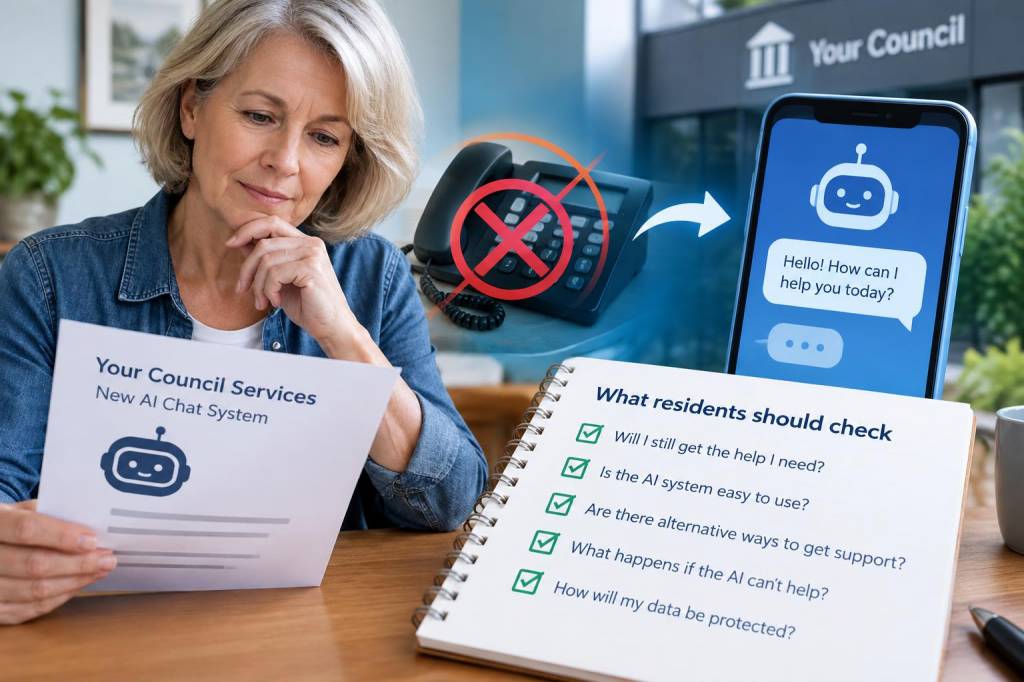
When a council says it is replacing phone lines with AI chat systems, I pay close attention. On paper, this can sound efficient: shorter queues, faster answers, lower costs, and 24-hour availability. In practice, it changes the way people reach public services, and that matters a great deal. If I were a resident facing that switch, I would want to know much more than whether a chatbot can answer a simple question. I would want to know what happens when a system fails, when a question is complicated, or when someone cannot use chat at all.
I think residents should treat this change as more than a technology update. It is a redesign of access. A phone line has a familiar shape: you call, wait, speak, explain, and often get routed to a human being. An AI chat system may look easier, but it can also create new barriers. Before accepting it, I would check several things carefully and ask councils to be clear, specific, and accountable.
What service is actually being replaced
I would start by asking whether a council is replacing every phone option or only some routine enquiries. There is a big difference between using AI for opening hours, bin collection dates, or council tax balance checks, and using it for housing problems, safeguarding issues, benefit disputes, or missed urgent repairs. A council may describe a new system as a “digital help desk,” but residents need to know which services remain reachable by phone and which do not.
If a council says it is moving “most” calls to chat, I would ask what “most” means in practice. Are residents still able to speak to staff about complex cases? Are emergency or vulnerable-person routes protected? Is there a clear human handoff when a chatbot cannot solve a problem? I would not be satisfied with vague promises. I would want a written service map.
Whether a human fallback still exists
This is probably the most important point. Any council using AI chat should still provide a genuine human fallback. Not a buried email form. Not a callback promise that takes days. Not a dead-end menu where the chatbot keeps repeating itself. A real route to a person is essential, especially for residents who are older, disabled, digitally excluded, distressed, or dealing with urgent problems.
I would ask councils to explain exactly how a resident can reach a human agent when the system cannot help. I would also want to know whether staff are trained to take over smoothly without forcing people to repeat everything from the start. Nothing frustrates residents more than explaining the same issue three times to three different systems.
Accessibility for people who cannot use chat easily
Many residents assume digital services are simple because they use them every day. Yet not everyone can type comfortably, read long on-screen prompts, or navigate a chatbot that misunderstands local phrasing. Some people have vision impairments. Some have cognitive difficulties. Some use older devices. Some rely on assistive technology. Others simply have poor internet access or low confidence with digital tools.
I would check whether the council has tested the chat system with real users from different backgrounds, including disabled residents and people with limited digital skills. I would want to know whether the system works with screen readers, whether it supports keyboard navigation, and whether it offers plain language rather than rigid, technical wording. If residents are being pushed into chat, accessibility cannot be an afterthought.
What data the system collects and stores
Whenever AI enters a public service, data questions matter. I would want to know what information the chat system collects, where it is stored, who can access it, and how long it is kept. Councils may use third-party vendors, and that means residents should understand whether their conversations are being used to improve a service, train a model, or monitor performance.
I would also ask whether sensitive personal details are being handled safely. If someone shares health information, financial stress, domestic abuse concerns, or housing risk, does the system treat that information with extra care? Does the council have a clear privacy policy in plain English? Are residents told when they are speaking to an automated system rather than a human? Transparency is not optional here.
Accuracy, errors, and responsibility
I do not think residents should assume AI chat is reliable simply because it looks polished. A chatbot can give a quick answer and still be wrong. It can misunderstand a question, miss an exception, or repeat a scripted response that sounds confident but does not fit the case. That becomes a serious problem when residents rely on it for deadlines, eligibility, complaints, or payments.
I would ask councils what safeguards are in place to catch errors. Is every answer checked against approved policy content? Are logs reviewed for incorrect guidance? Can residents flag mistakes easily? Most important, who is responsible when the system gives bad advice? If a resident loses time, money, or access to a service because of a chatbot error, the council must own that failure rather than hiding behind the technology.
Whether response times really improve
One of the main arguments for AI chat is speed, and I understand why councils make it. A 24-hour automated system can reduce pressure on staff and answer simple questions instantly. But residents should ask whether speed is only being measured at the first point of contact. A fast chatbot is not much use if it pushes people into a slower, more confusing process later on.
I would look for evidence, not slogans. Has the council published waiting time data before and after the change? Are more enquiries being solved on first contact, or are people being bounced between channels? Are residents getting answers faster overall, or just being diverted away from phone queues? Good service design should improve the full journey, not merely the first click.
Whether vulnerable residents are protected
I would be especially cautious about how councils treat vulnerable residents. Someone seeking help with homelessness, care support, child protection, debt, domestic abuse, or mental health may need a human conversation straight away. AI chat can be useful for routing, but it should never become a wall that blocks urgent support.
If I were checking a council’s plan, I would ask whether staff can identify vulnerability early in the chat flow, whether escalation rules are strict, and whether urgent cases are redirected without delay. I would also want to know whether residents can state that they do not want to use digital tools and still receive proper help. A public service must adapt to people, not force people to adapt to a machine.
What happens when systems go down
Digital systems fail. Networks fail. Vendors fail. Updates break things. So I would always ask what the backup plan is if the AI chat platform becomes unavailable. Is there another phone number? Is there a staffed office route? Can residents still report urgent issues if the system crashes during a busy period?
I would not trust a council that has no clear outage plan. Service continuity is not a luxury. If residents cannot report a missed bin, a broken street light, a housing emergency, or a payment issue because a chat tool is offline, then the council has simply moved the problem, not solved it.
Questions I would ask before accepting the change
When councils announce these systems, I think residents should ask direct questions. I would ask for plain answers on paper, not marketing language. These are the points I would press:
- Which services are moving to AI chat, and which remain available by phone?
- Can every resident reach a human being when needed?
- Does the chat system support disabled users and assistive technology?
- What personal data is collected, stored, and shared?
- How is accuracy checked, and who fixes errors?
- How are urgent or vulnerable cases escalated?
- What backup exists if the system fails?
- How will success be measured beyond cost savings?
A simple comparison residents can use
| Check point | Strong answer | Weak answer |
|---|---|---|
| Human fallback | Direct route to staff during every service hour | Generic form or delayed callback promise |
| Accessibility | Tested with disabled users and assistive tools | Only basic digital access claimed |
| Data use | Clear privacy notice and limited storage | Unclear vendor data practices |
| Escalation | Fast transfer for complex or urgent cases | Repeated chatbot loops |
| Service quality | Measured by outcomes and resident satisfaction | Measured only by cost cutting |
Why I think residents should stay alert
I am not against councils using AI. Used carefully, it can reduce repetitive admin, improve availability, and free staff for more demanding work. But public services are not retail support desks, and residents are not customers in a simple transactional sense. They often need judgment, empathy, discretion, and urgency. Those qualities cannot be reduced to a script without consequences.
That is why I would always read any council announcement with a practical eye. What is being improved, what is being removed, and who might be left behind? If residents ask those questions early, councils are more likely to build systems that serve people rather than simply automate contact. In my view, any switch from phone lines to AI chat should be judged not by novelty, but by whether ordinary people can still get clear, safe, and fair help when they need it most.